R&D revved up in the West
Rhonda Cornell
Australian ELECTRONICS ENGINEERING October 1999
.
 R&D on
the West Coast has been boosted with two $50,000 state government R&D grants being
awarded to local electronics companies, RF lnnovations and Quantum Digital Labs.
It was the first time either company has received grant assistance.
R&D on
the West Coast has been boosted with two $50,000 state government R&D grants being
awarded to local electronics companies, RF lnnovations and Quantum Digital Labs.
It was the first time either company has received grant assistance.
RF Innovations' M.D. Gary Sargeant obviously welcomes the $50K, but believes the telecommunication sector is often overlooked by grants committees.
"I find it enormously frustrating, given that telecommunications is the largest growth industry worldwide, yet the level of support for Australian R&D seems, at best, token only," he said. "We need to raise the awareness of governments to the importance of nurturing our own telecommunications R&D rather than just sponsoring overseas corporations with their own agendas."
He is aware of R&D grants being awarded to some companies who use the money to support the businesses' general cash flow. "We see scarce R&D grant money go to waste in this way."
He suggests an improved selection criteria for grants, whereby people who are involved in assessing applications have a relevant industry grasp.
Whilst the grant will be of some assistance in moving RF Innovations' R&D program forward, Mr Sargeant said it is a relatively small amount for telecommunications R&D lab budgets.
"Just the lease of a Vector Signal analyser will consume $50,000."
Quantum Digital Labs' technical director Roman Gdowski said the $50,000 grant is a big kick-off for his company, even though RF is an expensive science.
'The grant is actually pivotal for us to take the next step in improving the quality of commercial testing in WA," commented Mr Gdowski.
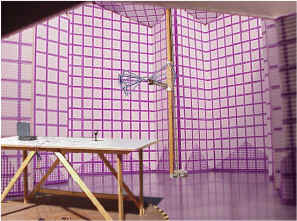
"The only other screened room facility is a small research chamber at Curtin University but it doesn't have the zero-reflection co-efficient inside which everyone's chasing. Their room is good for research but they can't do the commercial testing we can." Quantum received the grant to develop a 3m test site in Western Australia. Mr Gdowski explained that the ongoing goal of EMC testing has been the pursuit of a no-ambient/near-zero reflection environment in which to perform radiated emission measurements. The traditional solution has been Open Area Test Sites (OATS).
Mr Gdowski said the most important, but often overlooked, quality factor of these sites is the Site Attenuation Test (SAT). It is a quantitative measure of just how reflective the site is and determines its suitability for making measurements.
To replicate the OATS conditions in a laboratory the suppression of both the ambient and the reflections is required. Zero ambients can be achieved by simply building a shielded volume but to suppress the reflections sufficiently to meet the SAT requirement has been the nemesis of synthetic sites.
RF Innovations received the grant to help develop their radio modem to transmit large amounts of data at high speed.The modem, the RFI 2400, is capable of
2M full duplex traffic with a 10baseT data interface. In-built data routing permits branching connections at repeater sites for long haul links so that wayside sites can be connected to form a full distributed network.With fast channel switching and signal modulation/extraction, controlled by a DSP engine, the modem uses the 'free to air' 2.4GHz spectrum. It has a frequency-hopping algorithm to operate over path lengths of up to l5kms, depending on path dynamics. Radio frequency and software techniques means the modem can tolerate small fading margins yet still provide reliable data throughput, which would not be possible with conventional microwave data links.
The modem can be used as a reliable 'backbone' for point to point Ethernet and general purpose data interconnects, as well as for major intra-city data networks in conjunction with other technologies in a 'meshed' system. Another feature is the ability to 'stack' the modems to increase data throughput in any path. Synchro-nisation techniques in 'stacked' units, eliminates the problems of TX inter-modulation and receiver blocking, normally associated with multiple TX/RX co-sited locations.
Rhonda Cornell